Widowhood Today:
An Artist's Perspective
Life presents many challenges, yet it is not the challenges themselves that define us, but how we respond to them. Widowhood, in particular, often marks a pivotal moment of transformation—one that invites reflection, reinvention, and the search for new meaning.
Many widows experience profound isolation and invisibility as they navigate the uncertainty following the loss of a husband. For some, this period awakens a creative or expressive voice, inspiring them to bring visibility to the emotional, social, and spiritual struggles of widowhood. Years ago, resources to understand and process grief, pain, and absence were limited, making the journey even more challenging. Supportive spaces such as therapy and community groups, however, have provided meaningful avenues toward acceptance and self-renewal.

Charles Dana Gibson Illustration, A widow and her friends. New York: R. H. Russell; London: J. Lane, 1901. (seq.15) She Finds That Exercise Does Not Improve Her Spirits
Within widow support communities, shared experiences often transcend cultural or religious differences. Conversations among widows reveal common threads in how individuals cope, rebuild, and move forward. These communal stories and reflections serve as essential points of reference for artistic, social, and emotional exploration within the broader landscape of widowhood today.
In recent years, the growth of widowhood communities online has connected individuals to larger networks of support. A notable example is Modern Widows Club®, The Movement for Widow Care® (MWC), founded by Carolyn Moor in 2011 [1]. A women’s health organization that “gives widows a collective voice in society and the opportunity to find their new identity in life.” Through advocacy, education, and community-building, it reshapes long-standing perceptions of widowhood, recognizing widows as resilient, “empowering them to thrive as they move from grief to growth.”
-----------------------------------------
[1] “Widow Advocacy.” Modern Widows Club, modernwidowsclub.org/mission

Similarly, Widows’ Rights International [2], established in the United Kingdom in 2001, works to advance the human rights of widows worldwide. With the mission of “enabling widows to have a brighter—and fairer—future,” the organization works diligently to advance the human rights of widows worldwide. The United Nations’ designation of June 23 as International Widows Day in 2010 underscores the global scale of these issues and draws attention to the distinct challenges and needs faced by widows. As the UN emphasizes, “as societies, we owe it to the widows of the world to give them the respect, visibility, and unique support they need.”
-----------------------------------------
[2] “Widows' Rights International.” Widows' Rights International, www.widowsrights.org

Research has further highlighted these issues. In 2016, the Women’s UN Report Network (WUNRN) published Widowhood – A Systemic Violation of Human Rights & An Economic, Social & Humanitarian Crisis, [3] calling for urgent legal reforms, the elimination of discriminatory practices, and policies that protect the rights, dignity, and livelihood of widows worldwide. The report underscores widowhood as a global human

rights crisis, revealing how millions of widows continue to face cultural stigmatization, economic marginalization, and social invisibility.
-----------------------------------------
[3] Women’s UN Report Network. Widowhood – A Systemic Violation of Human Rights & An Economic, Social & Humanitarian Crisis. WUNRN, 2016. https://wunrn.com/2016/12/widowhood-a-systemic-violation-of-human-rights-an-economic-social-humanitarian-crisis/

In the United States, sociologist Dr Regina Kenen [4], herself widowed, has examined the historical and contemporary segregation of widows and how they navigate new roles in modern society. She calls for “greater attention to the plight of widows” and envisions how local organisations and institutions might cultivate more participatory and inclusive environments for those who find themselves “suddenly uncoupled.”
Dr. Kenen also revisits the term widow’s weed— a traditional mourning garment that symbolized social expectations placed upon widows. As she explains, “The costume set the woman apart, making them both visible and invisible at the same time.” This duality continues to echo in the lived experiences of many widows today, who often sense the lingering influence of these historical perceptions.
-----------------------------------------
[4] Kenen, Regina. “Suddenly Single: A Widow’s Challenge.” The Society Pages, July 2018, thesocietypages.org/specials/suddenly-single-a-widows-challenge/.
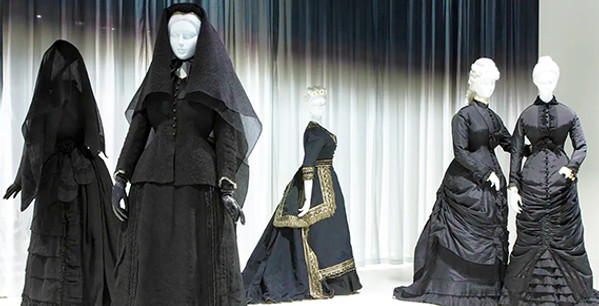
The legacy of mourning customs is explored in the 2014 Metropolitan Museum of Art exhibition Death Becomes Her, which “explores the aesthetic development and cultural implications of mourning fashions of the nineteenth and early twentieth centuries,” highlighting the visually codified ways society once distinguished widowed women from the rest of the community. Through its garments and historical context, the exhibit reveals how mourning attire made widowhood a highly public identity—one that both marked women’s loss and reinforced their separation within social life.

Death Becomes Her:
A Century of
Mourning Attire
© The Metropolitan Museum of Art
-----------------------------------------
[5] “Death Becomes Her: A Century of Mourning Attire.” The Metropolitan Museum of Art. www.metmuseum.org/exhibitions/listings/2014/death-becomes-her
Artistic Reflection: Widowhood and the Invisible Community
From my perspective, widow’s weeds extend far beyond historical costume; the symbolism of mourning fashion resonates with the isolation many widows feel. In response to Dr. Kenen’s call for greater awareness and inclusion, I find myself examining two essential questions:
-
What can I, as an artist, do to draw attention to the predicament of widowhood?
-
How can my artistic representations inspire communities across borders and grant widows a valued role in society today?
These questions arose during a period I call “survival mode,” when I relied on skills developed as a designer—feeling, observing, questioning, re-creating, and unraveling. Through this process, I encountered not only a woman shattered into a thousand pieces but also an invisible community that deserves to be seen with empathy and humanistic understanding.
We, the widow community, seek acceptance and empowerment. Such support is vital; it empowers us to thrive as mothers, sisters, friends, and active contributors to the social and cultural fabric that binds our societies together.
Broken by Circumstances, Restored by Choice
Losing a loved one can fracture identity and confidence, leaving one feeling chipped, cracked, and broken. For many widows, including myself, moments of grief are suspended in time—instants that steal the breath and upend reality. These experiences, whether recorded in journals or remembered internally, often return with a force that is both silent and overwhelming.
Acknowledging brokenness is the first step toward rebuilding. With the support and love of my family and community, I gradually understand how essential it is to acknowledge vulnerability to transform it into resilience, and I learned to lose, to win, to accept, and to forgive. This process mirrors the journey of many widows, who must reconstruct a sense of self after profound loss.

The Japanese art of kintsugi—repairing broken ceramics with gold lacquer—offered a powerful metaphor for this transformation. Rather than concealing the fractures, kintsugi highlights them, honoring the history of the object and elevating its imperfections into something more meaningful. In a similar way, widows carry their scars openly; these marks of grief become lines of strength, endurance, and unexpected beauty.
In my artistic practice, widowhood becomes both inspiration and armor. By exposing the cracks rather than hiding them, I transform vulnerability into a medium for reflection and renewal. This approach not only aids my own healing but also seeks to connect with others who share this invisible bond—inviting a collective reimagining of what it means to be broken, restored, and ultimately transformed by choice.