Jul 23, 2018
VIDEO SCULPTURE
Underwater Swimphony
Assignment:
Create a Jitter patch that creatively manipulates video. Develop a video sculpture in which digital footage responds to user input and produces an emotional output.
Concept
As a competitive swimmer, my relationship with the sport extends beyond the physical act itself—it exists underwater, on screens, and in memory. The sensation of being submerged in a body of water, surrounded by bubbles, splashes, and rhythmic noise, is a state of focus and joy that is difficult to articulate.
Underwater Swimphony translates this embodied experience into an interactive video sculpture. Competitive swimming becomes an audiovisual landscape, where movement, sound, and viewer interaction evoke the emotional intensity of gliding beneath the surface.
Process:
The sculptural form references the pool as both environment and container. I explored objects associated with swimming infrastructure and ultimately transformed a Styrofoam cooler into a projection surface.
The object was cut, painted, and textured in low relief to imitate pool tiles, then layered with a non-woven backing to better receive projected light.

The sculpture was assembled atop a large box that functioned as a pedestal, with the projector positioned beneath the pool form. This configuration allows the imagery to reflect upward, simulating the sensation of imagery emerging from an underwater space.
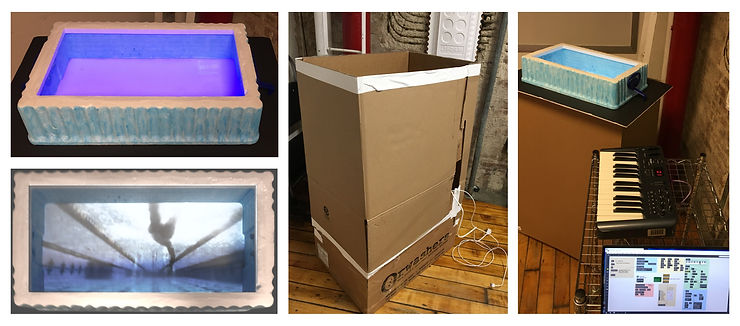

Video & Interaction:
Underwater footage from competitive swim races was sourced online and edited into a single video composition. Ambient, indistinct sounds from swim meets were collected and layered to recreate the acoustic environment of a race.
Using Max/Jitter, I mapped the video to a 24-key MIDI controller.

Visual parameters—including frame order, brightness, saturation, and edge detection—were assigned to modulation and pitch-bend controls.

This system allows viewers to manipulate the video in real-time by interacting with the controller. As a result, the projection at the bottom of the pool sculpture responds directly to user input.
The underwater imagery shifts, fractures, and intensifies, transforming the sculpture into a living, responsive pool of light and sound.