May 30, 2018
SOFT SENSING
Musical Shoes
Assignment:
In the first stage, work collaboratively to test and develop a specific type of sensor, focusing on a single primary material. In the second stage, further develop the project into a fully functional and aesthetically considered sensor-based interaction, emphasizing construction, physical implementation, and expressive potential.
Research & Concept:
Musical Shoes explores wearable interaction through movement and sound. Our group set out to create a pair of interactive shoes that generate music through foot gestures, transforming everyday motion into an expressive auditory experience.

We focused on conductive thread as the primary sensor material, while also experimenting with conductive fabric, conductive paint, Velostat, felt, and foam. The goal was to design pressure-sensitive sensors embedded in the shoes that respond to tapping, shifting weight, and stepping patterns.

Process & Implementation:
Conductive thread was used in the bobbin of a sewing machine, allowing us to stitch reliable electronic pathways directly into the shoe structure. This method proved highly effective and enabled clean integration of the sensors.
The conductive thread interconnected layered conductive fabric to form pressure sensors placed at key points on the shoes.
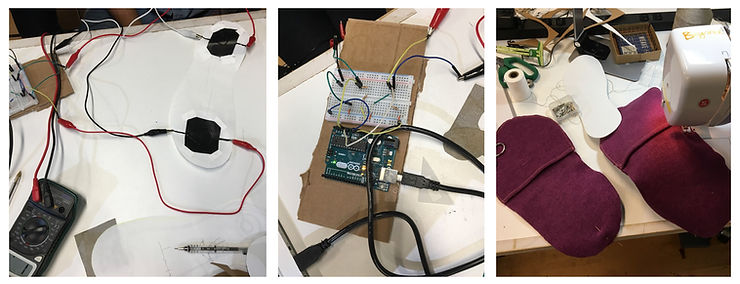
These sensors were connected to an Arduino, which read pressure data and transmitted it to a Max patch.

The Max patch translated sensor input into sound, allowing the shoes to produce musical notes and rhythmic patterns in response to the user’s movement.
Challenges & Lessons Learned:
-
Conductive thread proved more reliable and controllable than conductive paint, which can spread unpredictably and cause short circuits—particularly when used with Velostat.
-
Sensor performance improved significantly when conductive fabric layers overlapped precisely, increasing pressure sensitivity.
-
For a more durable and polished prototype, stronger structural materials are necessary for the shoe body and sensor housing.
May 31, 2018
One More
Project Development:
In the second phase of the project, we further developed the Musical Shoes prototype,
focusing on refining the physical design, improving sensor reliability, and making both shoes fully interactive. In the first iteration, only one shoe was functional; this version aimed for symmetry, durability, and a more cohesive user experience.
Materials & Construction:
We redesigned the shoes using synthetic black leather for the exterior and anti-slip fabric for the soles. The pressure sensors were layered over black foam to enhance responsiveness and comfort.

Conductive thread was sewn using a zigzag stitch, increasing the contact surface of each sensor and resulting in more consistent pressure detection.

To improve structure and longevity, we incorporated stiff fusible interfacing at the base of the shoes and a plastic mesh in the upper portion, balancing flexibility with support.
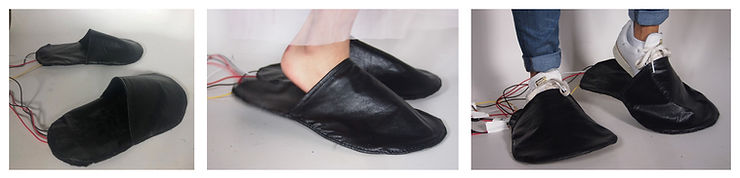
All components were assembled using hidden stitching techniques, creating clean edges and a more polished, finished appearance.
Outcome
By resolving issues from the initial prototype and refining both form and function, the Musical Shoes evolved into a more expressive, wearable, and performance-ready interactive system. This iteration significantly improved sensor performance, durability, and visual coherence.