May, 2018
SOFT ROBOTS
Inflatable Connections
Interactive Soft Sculpture | Pneumatic Interaction | Participatory Installation
Touch Through Air
Inflatable Connections is an interactive sculpture that examines how touch can be experienced through air, movement, and shared space.

This work invites participants to reflect on how proximity, personal space, and consent shift within a playful environment. In this setting, each action elicits a response, and every interaction is collectively negotiated, where inflatable Mylar shapes become the interface between bodies, transforming air into a form of communication.
Assignment
Design a soft robotic system that investigates material behavior, actuation, and interaction through experimentation with compliant materials and movement.
Inspiration
My interest in soft robotics began with a simple question:
Can touch be designed?
Coming from a background in textiles, I have always understood fabric as our closest architectural environment—the material that exists between our bodies and the world.
○──────────────◎──────────────○
Body Textile Touch
Skin, textiles, and surrounding space continually communicate through touch, making physical contact one of our earliest and most fundamental forms of interaction.
During the Soft Robotics course, I became fascinated by inflatable actuators as a way of extending that conversation.
While textiles mediate our experience of touch, they rely on the body to give them form and movement. Clothing, for example, only comes to life through its relationship with the wearer. This made me wonder what would happen if softness could move and respond on its own.
In the context of soft robotics, air became a material rather than simply a mechanism; it allows touch to be communicated through pressure, expansion, and gentle movement.
○──────────────◎──────────────○
Body Soft Robot Touch
Air is at the center of inflatable actuators that can contract, expand, twist, or bend. These air-filled actuators can mimic the adaptive movement of biological systems, opening new possibilities for human interaction, wearable technologies, and responsive environments.
At this intersection, I wanted to experiment with different materials, fabrication techniques, and design methods, not only to create inflatable actuators, but also to examine touch itself as a designed experience.

Fabrication as Design Research
As I developed and tested different inflatable geometries, materials, and fabrication methods, one recurring technical challenge became apparent: producing precise, repeatable heat seals by hand was slow and unreliable.
While this fabrication challenge did not alter the conceptual direction of Inflatable Connections, it opened another line of investigation focused on developing tools for fabricating inflatable forms more reliably.
That challenge became the starting point for Hot Dance, a parallel project developed during the XYZ Robots course.

While Hot Dance focused on developing a custom fabrication system capable of producing accurate, repeatable heat seals and cuts, Inflatable Connections continued exploring the experiential and interactive possibilities of inflatable structures.
Together, the two projects evolved in dialogue—one investigating how inflatable structures could be fabricated more efficiently, the other exploring how those structures could mediate touch, movement, and interaction.
Designing the Inflatable Modules

Soft inflatable actuators can display a wide range of deformation modes, including stiffening, contraction, bending, twisting, elongation, and omnidirectional motion, depending on their geometric configuration and internal architecture.

From this range of possibilities, I focused primarily on the contraction and expansion capabilities of these structures as a means of creating gentle, responsive interactions.
This principle is fundamental to both soft robotic actuators and the human body. Just as muscles and joints rely on their anatomical structure to bend, extend, and generate force, inflatable actuators rely on carefully designed geometric patterns that control how material folds, unfolds, and deforms as air pressure changes.
This led to the development of a repeated S-shaped geometry. Rather than simply expanding when inflated, each module was designed to contract vertically while simultaneously expanding laterally.
This dual movement allowed the inflatable forms to extend into the surrounding space. When assembled into larger structures, the expanding modules could gently approach and make contact with participants, using air pressure as a medium to translate pneumatic movement into an experience of touch.
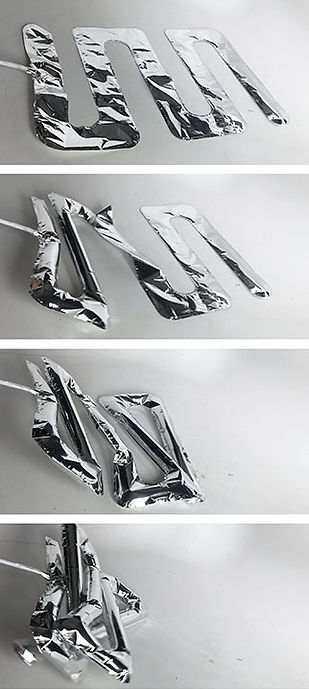
The “S” geometry therefore became fundamental to the project.

Using the fabrication workflow developed in Hot Dance, dozens of identical Mylar “S” modules were produced and manually assembled into vertical inflatable columns.

Each structure was suspended from above and connected to a foot-operated air pump.

Testing the air pump.
Together, they formed an interactive installation where movement was generated through collective participation.
Pneumatic Interaction
One person's action became another person's experience. As participants inflated the suspended structures through the foot-operated pumps, the expanding forms gently extended into the surrounding space, brushing against nearby bodies and subtly reshaping the environment. Air became the interface through which movement—and touch—were shared.
○──────────────◎──────────────○
Body AIR Touch
The installation invited playful encounters while raising subtle questions about proximity, personal space, and mediated touch. Who controls the interaction—the person pumping the air or the person experiencing the movement? Within the installation, these roles continually shifted, transforming touch into a shared, negotiated experience.
○──────────────◎──────────────○
Participant A AIR Participant B
Rather than relying on sensors or programmed behavior, the work responded entirely through human participation. Simple pneumatic mechanisms and manual foot pumps created a direct relationship between human effort, air pressure, and movement, allowing every interaction to unfold differently.

Art Exhibition | MVArtists | New Jersey, 2019
Inflatable Connections was exhibited during the Manufacturers' Village Artists Open Studios exhibition, where visitors collectively shaped the work through continuous cycles of inflation and deflation. Through air and movement, participants experienced how their individual actions could extend beyond their own bodies, reshaping their awareness of personal space, shared boundaries, and the collective experience of touch.
Reflection
Inflatable Connections explores how interaction can emerge through indirect contact. Rather than designing a system where technology responds to individuals, the project investigates how relationships between people, materials, and space can generate responsiveness.
By shifting touch from direct physical contact to a shared pneumatic environment, the project reimagines the boundaries between bodies, objects, and space. It suggests that interaction is not only created through intentional gestures but also through the invisible relationships between movement, environment, and the presence of others.